

A mid-market company can hit every project milestone and still arrive at go-live with an ERP environment the business is not ready to operate.
Configuration may be complete. Data may have been loaded. Interfaces may have passed testing. Users may even have attended training. Yet purchase orders still require offline clarification, finance teams maintain reconciliation spreadsheets, master-data ownership remains unclear, and support teams begin receiving incidents they were never prepared to handle.
This is why a GROW with SAP roadmap needs to measure more than implementation progress.
GROW with SAP is SAP’s cloud ERP offering built around SAP S/4HANA Cloud Public Edition, with predefined processes and a fit-to-standard implementation approach — a model that specialist GROW with SAP partners help mid-market organizations assess for organizational and process fit before the project begins. SAP currently positions SAP GROW as an entry point to cloud ERP for growing companies, with SAP S/4HANA Cloud Public Edition at its core.
For a mid-market organization, the more useful question is therefore not simply, “How quickly can we implement?”
It is: What must become operationally true before the business can run well on the new ERP?
That changes how the entire SAP Cloud ERP adoption journey is planned.
Start the GROW with SAP roadmap from the Run phase
Most ERP plans are constructed chronologically.
Assessment comes first. Configuration follows. Testing happens later. Then comes cutover, go-live, hypercare, and support.
A stronger approach starts at the opposite end.
Define what stable operations should look like after go-live, then work backward.
For example, who will own failed interfaces after the implementation team steps away? Who approves changes to master data? Who decides whether a process exception requires configuration, training, or a change in operating policy? What reporting must be available on the first financial close? Which support issues should be handled internally, and which require SAP or partner escalation?
These are Run-phase questions, yet the answers influence work much earlier.
That is one of the most important distinctions in a mature cloud ERP adoption plan: implementation readiness is about getting the solution into production; operational readiness is about knowing how the organization will use, support, govern, and improve it once it is there.
The SAP Activate methodology provides a useful structure for building that discipline. Its six phases are Discover, Prepare, Explore, Realize, Deploy, and Run.
SAP describes Prepare through Deploy as the four core delivery phases, with Discover and Run extending the journey before and after implementation.
The value comes from treating each phase as an adoption checkpoint rather than a calendar milestone.
Discover: decide what should actually change
The Discover phase is often treated as solution evaluation. For an effective GROW with SAP roadmap, it should also establish the business boundaries of the program.
A mid-market organization usually arrives with years of ERP decisions behind it. Some processes exist because they support regulatory, customer, or operational needs. Others exist because an old system could not support a better approach.
Those two categories should not enter a cloud implementation unquestioned.
Discovery should identify where standardization is acceptable, where differentiation is genuinely required, and where the organization is carrying unnecessary process history.
This is also the point to establish expected business outcomes in operational terms.
“Improve finance” is too broad.
“Reduce offline reconciliation between purchasing and finance” gives the project something observable.
“Improve inventory visibility” is broad.
“Create consistent inventory status across plants and warehouses” defines a clearer operating requirement.
A useful Discover-phase output is therefore a small set of business conditions that the new environment must support. These become reference points throughout the later GROW with SAP implementation phases.
Prepare: assign ownership before configuration starts
The Prepare phase begins the actual implementation project. SAP guidance includes project planning, governance, team setup, system preparation, scope preparation, and readiness for fit-to-standard activities. SAP Cloud ALM can be used to establish the implementation project and manage scope and project activities.
The practical issue for mid-market companies is usually ownership.
ERP projects often assign consultants to modules while leaving business ownership comparatively loose. That creates a problem later because configuration decisions begin to accumulate faster than the business can approve them.
Preparation should therefore answer questions such as who owns record-to-report decisions, who can approve changes to procurement policy, who owns material master quality, who validates customer data, and who has authority over integration priorities — ownership decisions that experienced SAP implementation partners help structure before configuration work begins in earnest.
The same applies to users.
Training should not first appear as an activity near go-live. During Prepare, the organization should already know which roles are changing significantly, which teams will need deeper process education, and which key users will participate throughout the implementation.
This is an important part of SAP S/4HANA Cloud Public Edition readiness because business participation is required well before the production system exists.
Explore: use fit-to-standard to challenge inherited complexity
Explore is where the adoption model becomes visible.
SAP uses fit-to-standard workshops to demonstrate predefined SAP processes and determine how those processes fit customer requirements. Customer line-of-business experts review the standard process, identify necessary adjustments, and provide information required for configuration, extensions, analytics, integrations, and other requirements.
The difficult part is rarely understanding the SAP process.
The difficult part is deciding whether the organization should change.
A department may say a five-step approval is mandatory because it has existed for eight years. Further examination may show that only two levels are policy requirements and the remaining approvals were introduced to compensate for poor visibility in the previous ERP.
That distinction matters.
A useful discipline during Explore is to classify every requested deviation according to its reason.
A requirement may be regulatory. It may be contractual. It may create genuine competitive differentiation. It may address an operational constraint that standard configuration cannot handle.
Or it may simply reproduce the past.
This creates what could be called a deviation budget. The term is not an SAP methodology concept. It is a practical governance mechanism.
Every departure from standard creates something the organization must understand, test, document, and maintain. Teams should therefore spend complexity deliberately.
SAP itself cautions that changes to standard processes can create additional maintenance work with future releases and recommends focusing changes on requirements that are genuinely necessary — the clean core discipline that a structured RISE with SAP program enforces to protect long-term upgrade stability.
A strong SAP Cloud ERP adoption program therefore leaves Explore with more than a requirements backlog. It leaves with clear reasons for why each significant deviation exists.
Realize: manage readiness in parallel tracks
The Realize phase is where configuration, extensions, integrations, data work, testing, and user enablement converge.
SAP’s current Public Edition implementation guidance covers process configuration, authorizations, extensibility, integration scenarios, data migration, and testing among the core implementation activities.
This is where a project plan can become misleading.
A dashboard may show configuration at 90 percent while data preparation is at 55 percent and user readiness is considerably lower. Overall project status may still appear green because all activities are averaged together.
For SAP Cloud ERP adoption, readiness should be tracked separately across at least five dimensions:
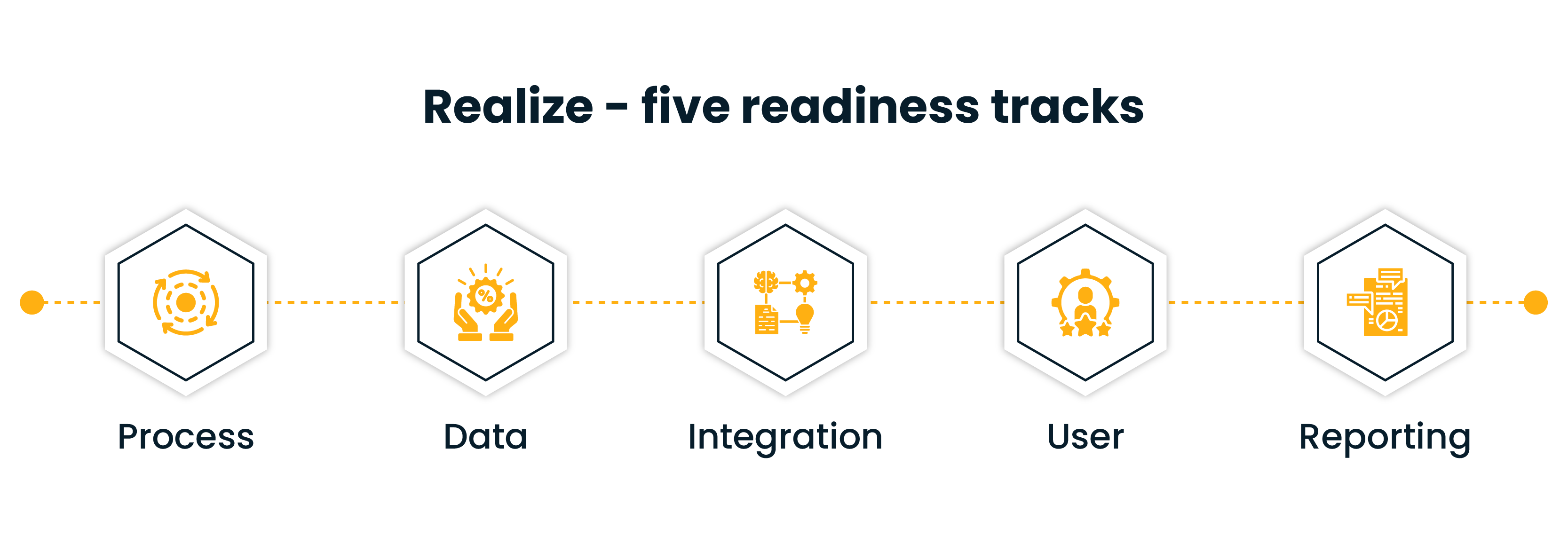
Process readiness asks whether future processes have been agreed, configured, tested, documented, and assigned to owners.
Data readiness asks whether required master and transactional data has owners, quality rules, cleansing actions, migration criteria, and validation procedures.
Integration readiness asks whether every interface has an owner, failure path, monitoring mechanism, test coverage, and operational support responsibility.
User readiness asks whether users understand the future process and their responsibilities, rather than simply whether training content has been distributed.
Reporting readiness asks whether operational and management decisions can be made from the new environment without immediately rebuilding the old spreadsheet estate.
This approach makes the GROW with SAP roadmap harder to game.
A project cannot claim broad readiness merely because technical configuration is progressing well.
Treat testing as evidence of operating readiness
Testing is another area where implementation logic and adoption logic diverge.
A test can prove that a transaction works.
It does not necessarily prove that a business process works under realistic conditions.
Consider order-to-cash. Testing an individual sales order, delivery, invoice, and accounting posting demonstrates system functionality. Operational readiness requires more.
What happens when credit status changes? What happens if master data is incomplete? What happens when an interface is delayed? Who sees the exception? Who owns it? Can the user resolve it without leaving the intended process?
This is where the SAP Activate methodology becomes more valuable when teams think in complete business scenarios rather than isolated transactions.
The objective should be to generate evidence that the organization can operate the process, including exceptions.
That is a much stronger readiness signal than a high test-case pass percentage alone.
Deploy: rehearse the first week of operations
Deploy naturally focuses attention on production readiness, cutover, go-live, and stabilization. SAP describes the phase as preparing the production environment, confirming organizational readiness, switching operations to the new system, and supporting the transition after go-live.
For mid-market companies, SAP Run-phase preparation should now become explicit.
Before go-live, teams should rehearse the operating model.
- Take a realistic incident and route it through support.
- Take a failed interface and confirm who receives the alert.
- Take a master-data correction and execute the approval path.
- Run the first-day operational reports.
- Walk through month-end responsibilities.
- Confirm who makes configuration decisions once the project governance structure begins to wind down.
This exposes a class of problems that conventional cutover planning may miss.
The system may technically be ready while the organization around it is still dependent on project-team knowledge.
The objective of Deploy should therefore be to reduce that dependency before it becomes a production risk.
Run is where the adoption case is tested
Go-live is an event. The Run phase is where the quality of the previous decisions becomes visible — and where structured SAP managed cloud services take over from the implementation team to keep integrations, master data, and process ownership current as the environment evolves.
SAP describes Run as the period in which customers drive adoption, respond to evolving business needs, adopt ongoing innovation, monitor and improve processes and integrations, and manage extensions.
That means the GROW with SAP roadmap should continue beyond system stability.
Traditional hypercare metrics usually focus on ticket volume and severity. Those are necessary, but they reveal only part of the operating picture.
A stronger set of adoption indicators looks for recurring business friction.
- Are users maintaining offline spreadsheets?
- Which transactions generate repeated support tickets?
- Where are approval workflows regularly bypassed?
- Which master-data defects repeatedly interrupt operations?
- Are integration failures concentrated around specific interfaces?
- Which process steps require manual rework?
- Are reporting teams recreating information outside SAP?
- Are cycle times improving, remaining unchanged, or getting worse?
These signals tell the organization whether users have actually adopted the intended operating model.
They also turn the Run phase into a structured improvement backlog rather than an indefinite support queue.
Build phase exits around evidence, not activity completion
There is a simple way to make the SAP Activate methodology more useful for adoption governance: change the question asked at the end of each phase.
Do not ask only whether the planned activities were completed.
Ask what the organization can now prove.
After Discover, can the company explain what business problems the ERP program is expected to address?
After Prepare, are ownership and decision rights clear?
After Explore, can every significant deviation from standard be justified?
After Realize, is there evidence across process, data, integration, user, and reporting readiness?
After Deploy, can the organization execute the operating and support model without depending entirely on the implementation team?
During Run, can it identify where adoption is working and where operational friction remains?
This makes the cloud ERP adoption plan considerably more useful because progress becomes tied to business capability.
The roadmap should end with an operating model, not a project closure
Mid-market organizations often choose GROW with SAP because they want a more standardized and manageable route into cloud ERP. SAP positions the offering around preconfigured processes and fit-to-standard adoption, supported by SAP Cloud ERP and partner-led implementation models.
Those characteristics can reduce unnecessary implementation complexity, but they do not remove the need for disciplined adoption.
The strongest GROW with SAP roadmap therefore connects every implementation decision to an operational question.
- Who owns this process?
- Who owns this data?
- How will this integration be monitored?
- How will users handle exceptions?
- What happens when SAP introduces new capabilities?
- How will the organization decide what to adopt next?
That is the real purpose of SAP Run-phase preparation.
The goal is not simply to reach production with SAP S/4HANA Cloud Public Edition.
It is to enter production with a business that understands how to operate, govern, support, and continuously improve the environment it has implemented.
That is when SAP Cloud ERP adoption moves beyond project completion and becomes part of how the company actually runs.