

An SAP system can be live while its support model is still unfinished.
The implementation team may have closed the cutover plan, users may be processing transactions, and production may appear stable. Yet the people who will support the system for the next several years may still depend on project consultants to diagnose interface failures, explain configuration decisions, trace custom logic, or identify the right business owner.
That dependency is one of the clearest signs that an SAP AMS transition is incomplete.
SAP itself treats go-live and ongoing operations as separate stages. Within SAP Activate, the Deploy phase includes go-live, sustainment, and hypercare. The Run phase then focuses on managing and supporting the productive solution, including incident management, monitoring, change management, and continuous improvement.
For an enterprise, the practical implication is straightforward: production access is not the same as production ownership.
A reliable SAP support model needs to be operating before the project team begins to step away — the transition discipline that specialist SAP managed cloud services teams build into hypercare planning so operational ownership transfers before implementation memory walks out the door.
Hypercare should reduce dependency, not simply reduce tickets
Hypercare is commonly measured through ticket volume.
The assumption is that once critical incidents fall and the system becomes stable, the business can exit hypercare.
That tells only part of the story.
A more useful SAP hypercare transition tracks two things simultaneously:
Production stability measures whether defects, failures, and business interruptions are declining.
Support independence measures whether the permanent support team can resolve problems without depending on implementation specialists.
The second measure is easy to overlook.
Suppose an integration fails during the third week after go-live. The AMS analyst notices the problem but needs the implementation consultant to explain the interface design, identify the relevant middleware flow, determine where the message failed, and provide the workaround.
The incident may still be resolved within the required time.
Operationally, however, the SAP support model is not ready.
SAP’s Activate guidance states that hypercare exit should include accepted outstanding issues, centralized project and process documentation, assigned support roles, defined escalation procedures, and established processes for continuous release cycles.
The exit decision should therefore test the support organization’s ability to operate, not only the health of the application.
Implementation knowledge and support knowledge are different
Most SAP projects generate substantial documentation.
There are configuration documents, functional specifications, technical specifications, integration designs, test evidence, role matrices, cutover plans, data-migration records, and training material.
All of that matters.
But much of it answers the question:
How was the solution built?
SAP post go-live support needs to answer another question:
What should someone do when the solution behaves unexpectedly?
That requires different knowledge.
Consider an inbound customer-order interface.
The design document may describe source fields, target fields, mappings, middleware components, and authentication.
The support team also needs to know what a failed message looks like, where the error becomes visible, whether automatic retry exists, which errors can be replayed safely, which errors require master-data correction, who owns the upstream system, and what happens to the business process while the interface is unavailable.
That information is often scattered across email threads, defect tickets, consultant notes, and the memories of people who built the integration.
A serious SAP AMS transition has to capture that operational knowledge before those people leave.
Do not hand over an unclassified backlog
Open issues at go-live are normal.
An unstructured backlog is not.
One of the most useful activities in SAP production support planning is to classify every unresolved item before responsibility moves to AMS.
An item might be a production defect. Another may have a documented workaround. A third could be a data-quality problem. Another may require additional user training. Some requests may already be enhancements rather than incidents — the classification work that structured SAP optimization and enhancement services govern from the first day of steady-state support.
Those categories should not enter support as one generic list.
A production defect needs severity, ownership, root-cause status, workaround information, and an expected resolution path.
A known error needs diagnostic guidance.
An enhancement needs prioritization and change governance.
A training problem needs business ownership.
A data issue needs a named data steward.
Otherwise the AMS team receives a backlog without knowing which commitments belong to the implementation project and which belong to steady-state support.
This is also where commercial misunderstandings begin. A business stakeholder may expect an old project enhancement to be completed under an incident SLA while the AMS provider considers it a new change request.
Good ERP support governance removes that ambiguity before handover.
Build support around resolution paths, not just L1, L2, and L3
L1/L2/L3 is useful for organizing support responsibilities, but the model can become too abstract.
An incident rarely behaves like a clean three-step escalation.
Take a failed invoice posting.
The cause could be user input, master data, configuration, authorization, an integration, custom code, a background job, or an SAP product issue.
For every major process, the SAP support model should therefore answer four operational questions:
- Who detects the problem?
- Who diagnoses the likely cause?
- Who can perform the corrective action?
- Who approves the business consequence?
The answers may involve different teams.
An L2 functional consultant may diagnose an accounting configuration issue. A technical consultant may implement the correction. A finance process owner may need to approve the resulting business change.
For a failed integration, an AMS analyst might detect the failure, an integration specialist might diagnose it, an external application team might execute part of the correction, and a business owner might determine whether messages can be replayed — the cross-team resolution model that dedicated SAP integration services teams are structured to coordinate across system boundaries.
This resolution-path model makes SAP post go-live support much more usable during real incidents.
Define SLAs around business impact
Severity definitions are another common source of friction after go-live.
“Critical,” “high,” and “medium” appear straightforward until users, support teams, and service providers interpret them differently.
A better model connects priority to business impact.
A failed interface affecting one non-urgent transaction is different from the same interface preventing an entire plant from processing goods movements.
A reporting issue during a normal week may have moderate impact. The same issue during financial close can become urgent.
An effective SAP support model should therefore consider business calendars as well as system symptoms.
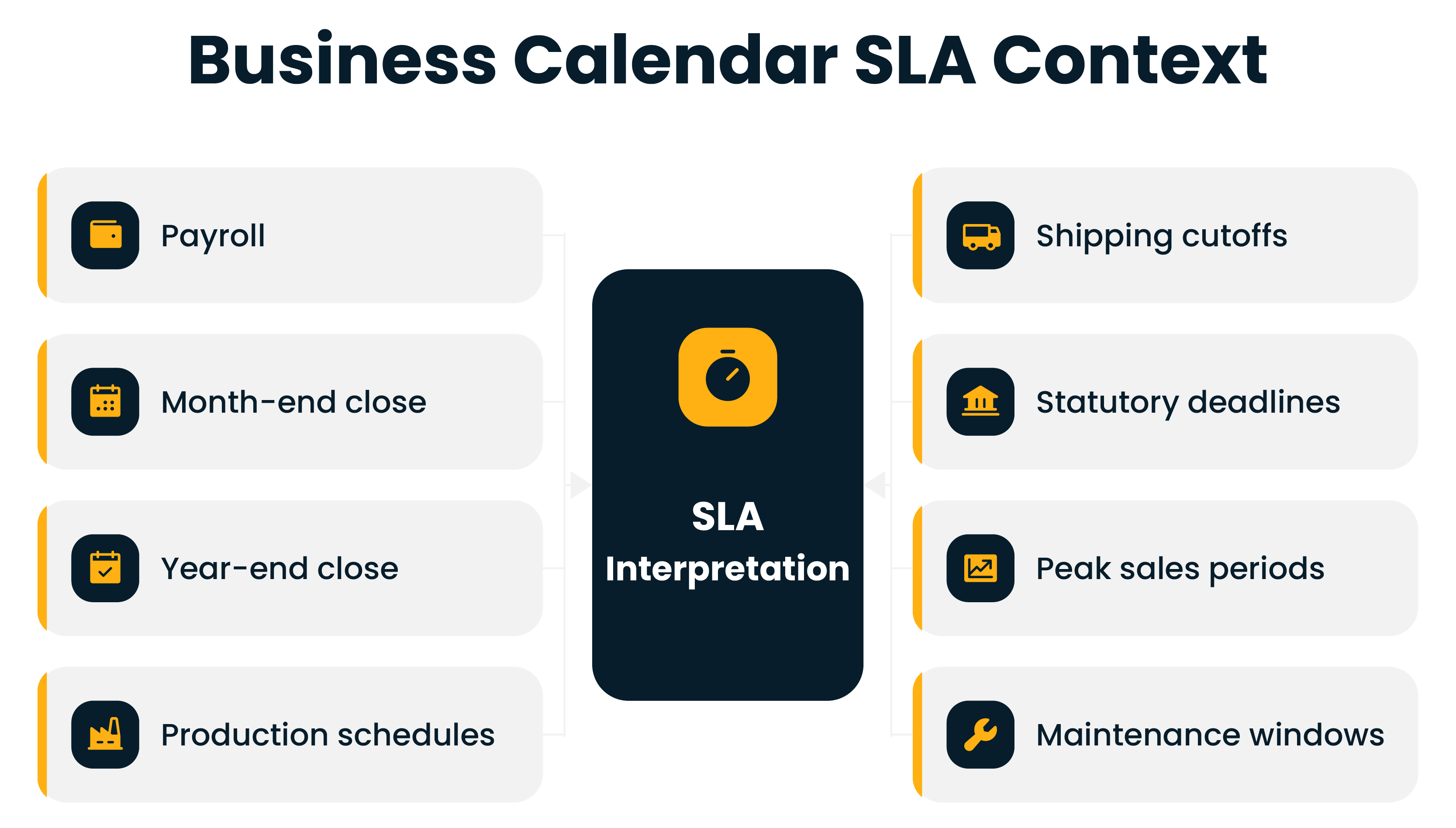
Useful context includes payroll periods, month-end and year-end close, production schedules, shipping cutoffs, statutory deadlines, peak sales periods, and planned maintenance windows.
This allows escalation rules to reflect how the business actually operates.
SLAs define expectations. Business context determines whether those expectations are meaningful.
Monitoring must be ready before support takes ownership
Support cannot respond consistently to conditions it cannot see.
SAP Cloud ALM includes operations capabilities for monitoring processes, integrations, exceptions, alerts, and other technical or application conditions. Its Integration and Exception Monitoring capability, for example, allows teams to review messages, exceptions, and alerts across managed components.
The specific monitoring stack will vary by SAP landscape, but SAP support readiness should establish several things before hypercare ends.
The AMS team should know which systems are monitored, which alerts matter, who receives them, what thresholds generate action, and how technical alerts are connected to business impact.
This also applies to proactive support.
If an interface repeatedly fails at the same stage every week, closing each ticket individually is poor support practice. The pattern should move into problem management and eventually into an improvement backlog.
SAP itself describes application-management services as including incident resolution, problem handling, change requests, service requests, monitoring, and continuous optimization.
That broader view is important for SAP post go-live support. The objective is stable operation, not an efficient ticket-closing machine.
The support team should practice before taking ownership
Knowledge-transfer sessions are useful. Operational rehearsals are better.
Before completing the SAP AMS transition, give the incoming team realistic situations and observe what happens.
- Provide an integration failure.
- Introduce an authorization problem.
- Give them a failed background job.
- Create a functional incident involving incorrect master data.
- Ask them to route an issue that requires SAP product support.
- Give them an enhancement request disguised as a production incident.
The team should be able to determine the likely path without immediately calling the implementation consultant who originally configured the area.
This kind of rehearsal reveals missing documentation quickly.
It also surfaces ownership gaps that workshop-based knowledge transfer tends to hide.
The implementation consultant may believe an issue belongs to Basis. Basis may expect the integration team to own it. The integration team may require the business team to correct data first.
Finding that disagreement during a rehearsal is considerably easier than discovering it during a production disruption.
A practical AMS handover checklist
Before closing hypercare, the AMS handover checklist should confirm evidence across the following areas:
- Process ownership: Critical SAP processes have named business and application owners.
- Support scope: L1, L2, L3, SAP, customer, partner, and third-party boundaries are documented.
- Open backlog: Defects, known errors, workarounds, data issues, enhancements, and training items are separately classified.
- Documentation: Configuration, integrations, custom developments, jobs, interfaces, roles, known errors, and diagnostic procedures are accessible to support.
- Monitoring: Production monitoring is active, alerts have owners, and escalation actions are documented.
- Incident management: Severity rules, SLA expectations, routing logic, communication paths, and major-incident procedures are agreed.
- Access: AMS personnel have the required production, monitoring, ticketing, and support-system access.
- Business calendar: Close periods, payroll, plant schedules, statutory dates, and other critical windows are visible to the support team.
- Change management: Enhancement intake, approvals, testing, transports, releases, and emergency changes have defined ownership.
- Operational rehearsal: Support teams have resolved representative incidents without relying on undocumented project knowledge.
- Hypercare exit: Outstanding items have been formally accepted by the teams that will own them after project closure.
- Improvement governance: Recurring problems, technical debt, automation opportunities, and enhancement requests have a separate review mechanism.
SAP’s Activate content similarly identifies helpdesk setup, incident management, post-go-live change management, user operations, hypercare, documentation, role assignment, and escalation procedures as part of operational preparation.
The checklist should therefore be treated as an operational acceptance test, not an administrative sign-off.
Support staffing should follow the landscape, not the org chart
A mature SAP AMS transition also questions whether the proposed team matches the actual production environment.
Staffing decisions should consider business criticality, geographic coverage, functional scope, integrations, custom developments, Basis requirements, release activity, ticket patterns, and dependencies on third-party systems.
A highly standardized environment with a small integration footprint has different support needs from an SAP landscape connecting plants, warehouses, banks, tax platforms, customer systems, EDI networks, and custom applications.
The same principle applies to support hours.
Twenty-four-hour coverage should exist because the operating model requires it, rather than because it sounds comprehensive.
This is why SAP production support planning should be based on real business operating periods and failure impact.
Hypercare exit is the beginning of the run model
The purpose of the SAP hypercare transition is to move from project-driven stabilization into repeatable operations.
That transition is complete when the permanent support organization can handle normal incidents, recognize exceptions, coordinate escalations, govern changes, maintain documentation, monitor critical processes, and identify recurring problems.
The Run phase then becomes broader than maintenance. SAP describes it as ongoing operations, support, adoption, process improvement, monitoring, optimization, and continued use of new capabilities.
That should also shape ERP support governance.
Operational reviews should examine recurring incidents and service performance.
Problem management should identify patterns rather than repeatedly resolving symptoms.
Change governance should decide which enhancements deserve investment. Business and IT owners should periodically review whether processes are being supported effectively — the ongoing review discipline that SAP annual maintenance services formalise by keeping release assessment, enhancement backlogs, and process ownership current across each update cycle.
The SAP support model then becomes part of ERP management rather than something activated only when an incident occurs.
The real handover is transfer of operational confidence
Documents can be transferred in a day.
Production ownership cannot.
A successful SAP AMS transition happens when the support team understands enough of the environment to make reliable decisions without depending on project memory.
That requires more than knowledge-transfer meetings. It requires issue ownership, diagnostic guidance, monitoring, support access, escalation rules, business calendars, change governance, and evidence that the incoming team can operate the system.
The strongest test of SAP support readiness is therefore simple.
When an unfamiliar production issue appears after the implementation consultants have left, does the support organization know where to start, who needs to become involved, what the business impact is, and how the issue should move toward resolution?
If the answer is clear, SAP post go-live support has a workable foundation.
If the answer still depends on knowing which project consultant to call, the handover is not finished.