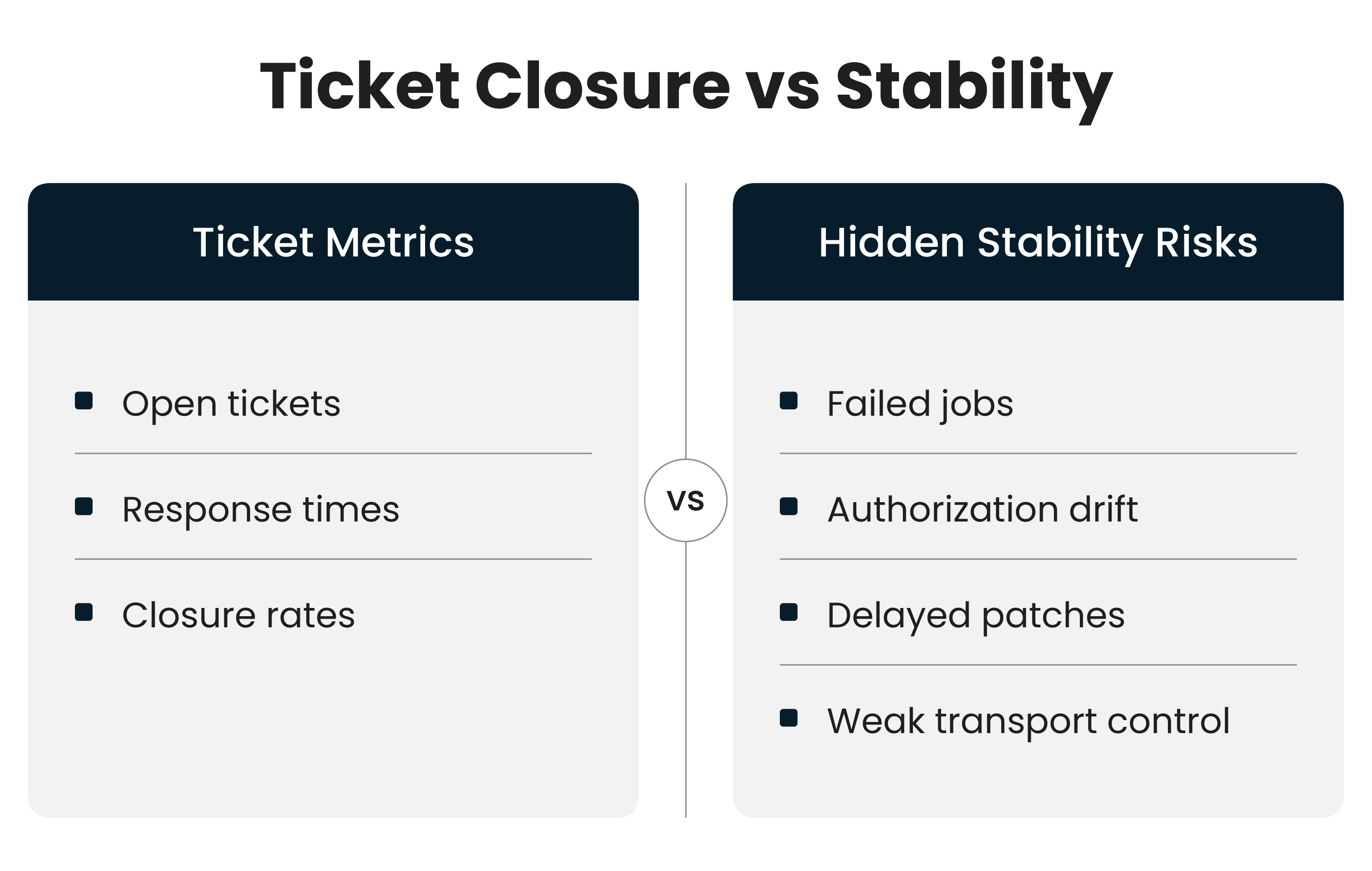
SAP teams often talk about support performance in terms of open tickets, response times, and closure rates.
Those measures have value. They still do not explain whether the environment is actually stable.
An SAP production landscape can have an efficient ticket queue and still carry unresolved technical risk. Background jobs may be failing intermittently. Authorizations may have drifted over time. Performance may degrade during business peaks. Transports may be moving into production with weak discipline. Security notes may be delayed. User access reviews may be overdue. None of these issues looks dramatic in isolation. Together, they create the conditions for disruption.
This is where SAP Basis support and SAP security support become more than support functions. They become stability functions.
A mature AMS model should not be judged only by how well it reacts after a failure appears. It should also be judged by how effectively it prevents instability from reaching the business in the first place — the operational standard that structured SAP managed cloud services build into their operating model through continuous monitoring and proactive technical control.
Ticket closure is an incomplete measure of SAP stability
A resolved ticket says that one issue was addressed. It does not say whether the operating conditions behind that issue were understood or corrected.
Consider a few common examples.
A user reports poor performance during month-end processing. The ticket gets closed after a restart or a one-time adjustment. If capacity patterns, expensive jobs, or poorly timed background processing remain unchanged, the condition will return.
A role issue gets corrected for one user. If the wider authorization design is inconsistent, the same problem will surface again elsewhere.
A failed interface is restarted and the incident is marked complete. If job sequencing, monitoring thresholds, or transport dependencies are still weak, the underlying exposure stays in place.
This is why SAP AMS services should separate reactive support from preventive operational control. Reactive support is necessary. It is not enough to guarantee continuity.
Stability depends on technical control before the incident
The business usually experiences SAP instability in business terms.
Orders do not process. Reports do not reconcile. Approvals do not reach managers. Month-end runs late. Batch jobs fail. Users lose access. A transport causes unexpected behavior. Auditors question access controls.
The technical causes usually begin earlier.
That is why SAP production support should be viewed as a continuous control function. Basis and security teams are not only there to respond when something breaks. They are there to maintain the health of the production environment so that failures are less likely, less disruptive, and easier to recover from.
This includes monitoring, performance analysis, transport governance, technical patching, role administration, access reviews, and production-readiness checks. Together, these activities create the technical hygiene that the business rarely sees directly, but depends on constantly.
Basis and security work as one stability layer
Organizations sometimes treat Basis and security as separate administrative tracks. In practice, stability often depends on how closely they operate together.
A system can be technically available and still be unstable if users do not have correct access, critical jobs cannot run under the right authorizations, or emergency access controls are poorly managed.
Likewise, a secure environment can still become operationally weak if performance issues, transport problems, or unattended background failures reduce reliability.
This is why SAP Basis support and SAP security support should be connected inside the AMS model. The shared objective is not only system administration. It is operational confidence.
That confidence depends on whether the environment is observable, controlled, and reviewable.
Introduce a Stability Control Loop
A practical way to explain this is through a Stability Control Loop.
This is not an official SAP framework. It is a way of understanding how proactive AMS work protects the environment.
The loop has five activities:
- Observe: Track system behavior, performance, jobs, interfaces, access patterns, and technical events.
- Detect: Identify failures, exceptions, unusual trends, recurring warnings, or control deviations early.
- Control: Apply corrective action through patching, role changes, transport discipline, job correction, tuning, or access remediation.
- Validate: Confirm that the action worked and that the business process or technical service is stable again.
- Review: Examine whether the issue points to a broader pattern, control gap, or recurring operational weakness.
This loop is what differentiates governed SAP AMS services from simple ticket handling. It shifts attention from “what broke” to “what needs to stay healthy.”
SAP system monitoring is the starting point, not the full answer
Good SAP system monitoring is essential, but monitoring alone does not create stability.
A mature monitoring practice should cover system availability, background jobs, performance behavior, interface health, database conditions, spool activity, update errors, and other operational signals that matter to the landscape.
The more important question is what happens next.
An alert that no one reviews in time is not a control. A dashboard that does not connect to action is not a stability mechanism. Monitoring becomes valuable when it supports faster detection and better operational decisions.
This is especially important in production support, where the goal is not just seeing a failure, but understanding how it affects business continuity. A failed batch job may impact invoicing, payroll interfaces, procurement processing, or financial posting cycles. The AMS team needs to know which failures matter first and who owns the next step.
That is the difference between technical visibility and operational control.
Authorization design affects system stability more than many teams admit
Security is often discussed mainly in terms of risk and compliance. In operational reality, SAP authorization management is also a stability issue.
If users cannot execute the transactions, apps, or workflow steps required for daily work, the environment becomes unstable from a business point of view. If authorizations are overly broad, the system may remain usable but become harder to control and defend during review. If role changes are made without enough coordination, production issues can appear in the form of blocked processes, failed approvals, or unintended access conflicts.
SAP security support should cover more than user administration. It should include role maintenance, access consistency, emergency-access control where relevant, and timely resolution of production access issues without compromising governance — the security discipline that mature
SAP optimization and enhancement services maintain alongside functional improvements to ensure the environment stays both usable and controlled.
A stable production environment depends on both availability and controlled usability.
Access reviews connect technical operations with audit readiness
Access reviews are often treated as periodic compliance exercises. In a mature AMS model, they should also be treated as maintenance of control integrity.
Over time, SAP access can drift. Users change roles. Temporary access becomes permanent. Approvals are forgotten. Legacy assignments stay active even when business responsibilities move elsewhere.
If this goes unchecked, the environment becomes harder to govern. It also increases the risk that production support becomes tangled in avoidable access issues.
Regular access reviews help confirm that the role model still reflects actual business responsibilities. They also support segregation-of-duties discipline and reduce surprises during audit activity.
This is one of the clearest places where SAP security support connects directly to business confidence. The business wants users to have the access they need. Audit and compliance teams want that access to remain controlled. AMS support has to help both outcomes coexist.
Patch management protects more than security posture
SAP patch management is often framed only as a security obligation. It also supports production stability.
Delaying technical maintenance can leave the landscape exposed to known issues, compatibility concerns, or unaddressed defects. Applying changes without planning can create a different problem by introducing disruption without adequate validation.
That is why patching should be treated as controlled operational maintenance. The AMS team should know what needs to be applied, how it affects the landscape, how it will be tested, when it can move safely, and what rollback or recovery planning exists if results differ from expectation.
In a well-run support model, patching is neither neglected nor rushed. It is governed.
This is another area where the quality of SAP Basis support becomes visible. Strong Basis teams reduce uncertainty around maintenance events because they understand system dependencies, transport coordination, and production timing.
Transport governance is one of the most overlooked stability controls
Many SAP production issues do not start with hardware or security events. They start with a change moved into the environment without enough control.
Transport discipline is therefore central to SAP production support.
A transport should not be treated as a routine technical move. It is a production event that can affect configuration, code, authorizations, workflow behavior, forms, reports, and integrations.
Good governance means knowing what is being moved, why it is being moved, whether it has been tested properly, what dependencies sit around it, and who approved the release — the transport and integration discipline that specialist SAP integration services teams enforce to prevent avoidable production disruption. It also means having a clear view of sequencing, because a technically correct transport moved in the wrong order can still cause disruption.
When transport control is weak, ticket volumes often rise afterward. Teams then spend time fixing the impact of avoidable production movement. When transport control is strong, stability improves quietly in the background.
Background jobs and batch operations deserve constant attention
Background jobs are easy to take for granted when they are working. They quickly become visible when they are not.
Many SAP environments rely heavily on scheduled jobs for postings, reconciliations, file creation, interfaces, reporting, document output, and housekeeping tasks. A failure in this layer may not surface immediately to end users, but it can create a chain of business consequences.
That is why SAP system monitoring should include strong oversight of job behavior, completion status, timing, and exceptions.
More importantly, the AMS team should understand which jobs are merely technical and which ones are business-critical. A failed cleanup job matters differently from a failed billing or finance-related batch process. Prioritization depends on business context, not only on technical severity.
This is another example of why Basis operations and functional support need to stay connected in a mature AMS model.
Performance tuning is part of business continuity
Performance is often addressed only after users start complaining. That creates a reactive cycle that most organizations would rather avoid.
SAP performance tuning should be part of ongoing operational review. The team should watch response behavior, heavy workloads, recurring bottlenecks, background processing patterns, and system stress during known business peaks such as period close, payroll, seasonal order volumes, or reporting cycles.
The purpose is not to chase perfect technical metrics. The purpose is to maintain reliable business execution.
A stable environment is one where users can complete work consistently, not just one where the system remains technically up. That is why performance tuning belongs alongside monitoring, job control, and transport governance inside SAP Basis support.
Production support maturity comes from prevention, not only recovery
Recovery capability matters. Every support model needs it.
The stronger measure of maturity is how much instability is prevented before the business feels it.
This is the practical distinction between reactive incident support, preventive technical support, and governed production support.
Reactive support closes what has already failed.
Preventive technical support watches for the conditions that create failure.
Governed production support combines prevention with controlled change, validation, and review so the environment remains dependable over time.
This is the level that many organizations look for when they evaluate SAP AMS services seriously. They are not only buying ticket resolution capacity. They are looking for stability stewardship.
Technical hygiene is business continuity work
Basis and security activities are sometimes described as maintenance overhead. That understates their role.
When monitoring is disciplined, jobs are supervised, patches are governed, performance is reviewed, roles are controlled, and access is validated, the business gains something very practical: continuity.
Transactions complete more reliably. Users experience fewer avoidable access disruptions. Releases move with greater confidence. Month-end activities face fewer technical surprises. Audit questions are easier to answer. Operational teams spend less time firefighting.
That is the business value of SAP Basis support and SAP security support in an AMS context.
Why mature AMS models invest in proactive Basis and security support
A well-run AMS function should do more than respond to production events. It should help create an environment where those events are less frequent, less severe, and easier to control when they do occur.
That is why strong SAP AMS services include proactive Basis and security work as a core part of the operating model. Monitoring, authorizations, patching, jobs, transports, performance, and access reviews should not sit at the edge of support. They are part of the support foundation.
For organizations evaluating AMS providers or strengthening their current model, this is a useful test: does the support approach focus only on resolving incidents, or does it actively protect stability, continuity, and audit readiness? – the evaluation lens that
SAP annual maintenance services providers should be held to at every release and review cycle.
That answer usually says more about the maturity of the AMS model than any ticket dashboard ever will.