
SAP AMS Governance: How Talent Pods Help Manage Incidents, Changes, Enhancements, and SLAs
The most expensive part of AMS governance rarely appears in an SLA report.
It appears between two pieces of work.
An incident is restored within target time, but permanent correction waits for a developer. A recurring service request is identified as an automation candidate, but nobody owns the improvement. A functional change is complete, while an integration dependency holds the release. A production defect reaches Basis, ABAP, and the business team before anyone takes end-to-end responsibility.
Each queue can perform well while the business still waits.
This is an important weakness in SAP AMS governance, especially when enterprises need the right SAP service provider to manage incidents, changes, enhancements, and SLA expectations together. Incidents, service requests, changes, and enhancements need different controls, yet they all operate against the same SAP landscape. Once ownership, technical context, or business intent is lost between them, SLA performance starts to tell only part of the service story.
Dedicated SAP Talent Pods address this problem from a staffing and operating-model perspective. The goal is to keep the right SAP functional, technical, integration, Basis, and testing capability close enough to the environment that work can move from diagnosis to correction, release, and improvement without repeatedly rebuilding context.
Why Does SAP AMS Governance Break at Handoffs?
Most AMS organisations already have defined processes.
Incidents receive priorities. Requests enter service queues. Changes go through approval. Enhancements compete for delivery capacity. Releases have calendars.
The weakness usually appears when one category needs to become another.
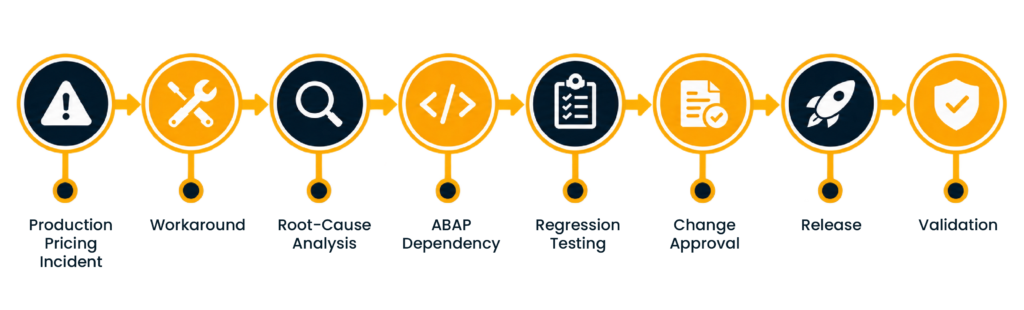
A production pricing problem illustrates the issue, especially when SAP integration services are needed to connect downstream systems, middleware, and business process dependencies. The service desk records an incident. A functional consultant restores service through an approved workaround. Further investigation identifies an ABAP dependency, and the permanent correction needs testing across order entry, pricing, delivery, billing, and Finance.
The original incident may already be closed.
The business requirement has not disappeared.
Someone now has to preserve:
- The production symptom
- Root-cause evidence
- Affected business processes
- Technical dependencies
- Required change
- Regression scope
- Business validation
- Deployment timing
If that information is reconstructed at every handoff, resolution time expands without necessarily breaching the original incident SLA.
A useful governance metric is therefore handoff latency: the time an issue spends waiting for new ownership, clarification, specialist allocation, approval, or release movement after the initial service has been restored.
This is not an SAP-defined KPI. It is a practical way to expose delays hidden by queue-level reporting.
How Should Incidents, Requests, Changes, and Enhancements Be Governed Differently?
Good SAP production support starts by recognising that each type of demand has a different purpose, where SAP consulting services help define governance across incidents, changes, enhancements, and service ownership.
| Work type | Primary objective | Governance question |
|---|---|---|
|
Incident |
Restore disrupted service |
How quickly and safely can business operations resume? |
|
Service request |
Fulfil a known, repeatable need |
Can this be handled consistently or automated? |
|
Change |
Alter the productive environment safely |
Is impact understood, tested, approved, and deployable? |
|
Enhancement |
Improve business or system capability |
Is the improvement valuable enough to consume delivery capacity? |
The categories should remain distinct.
The governance model should connect them.
A recurring incident should have a defined path into problem analysis and permanent correction. A frequently repeated service request should be assessed for automation. An approved enhancement should flow through SAP change management and release controls. A failed change should feed directly back into incident and problem analysis.
Mature AMS treats these transitions as part of the operating model rather than exceptions to it.
Where Do SAP Talent Pods Improve Incident Management?
The first advantage is retained application context.
Shared resource pools can give an enterprise access to strong specialists. A different consultant may still need time to understand local configurations, custom objects, known errors, interfaces, business calendars, previous releases, and unwritten operational dependencies.
A dedicated Talent Pod develops that context continuously.
Depending on the SAP estate, the pod can bring together skills such as:
- SAP functional consulting
- ABAP development
- SAP Basis
- Integration expertise
- Testing and quality assurance
- Application support coordination
- Specialist capability added when the landscape requires it
This does not mean every incident needs several consultants.
It means the expertise required for escalation is already connected to the same support structure.
For SAP incident management, that continuity improves more than initial response. It helps the team recognise repeat issues, connect symptoms across components, and determine whether the next action should be operational recovery, root-cause investigation, configuration correction, code change, or process improvement.
The work is less likely to restart every time it changes hands.
What Should Happen After an Incident Is Restored?
Closing the incident and closing the problem should be treated as separate outcomes.
Suppose an interface fails because malformed master data causes a downstream processing error. Support corrects the record and reprocesses the message.
Service has been restored.
The AMS team still needs to determine whether the same condition can recur.
That may require:
- Identifying the master-data source.
- Confirming why invalid data was accepted.
- Checking whether other records carry the same defect.
- Reviewing interface validation.
- Deciding whether the fix belongs in data governance, configuration, code, or process control.
- Testing the permanent correction.
- Deploying it through a controlled change.
This is where SAP AMS best practices need to go beyond response and resolution targets.
Repeat incident rate, known-error ageing, root-cause closure, and permanent-fix lead time reveal whether production support is improving the system that generates the tickets.
How Should SAP Change Management Connect With AMS?
A change should retain the context that caused it.
SAP Cloud ALM supports change and deployment management using features that can document changes, associate transportable objects, support approvals, and orchestrate deployment through the implementation landscape. SAP also supports relationships between requirements, user stories, test cases, and features.
The AMS governance model should preserve a comparable operational chain:
production issue → business impact → approved solution → change → testing → release → post-deployment validation
This becomes particularly important when an apparently small SAP correction touches several components.
A Finance configuration change may affect an interface. An ABAP correction may require a transport sequence. A role adjustment may alter process controls. A production fix may need to avoid month-end close.
The Talent Pod model helps because functional, technical, Basis, integration, and testing knowledge can participate in the same change context.
The change does not arrive as an isolated technical request.
Why Should SLA Management Look Beyond Ticket Response?
Traditional SAP SLA management often concentrates on response and resolution by priority.
Those measures remain necessary. They tell the enterprise whether operational commitments are being met.
They do not fully describe business-service health.
SAP Cloud ALM Business Service Management allows systems and services to be grouped into business services, with service-level objectives defined at a global or individual business-service level. SAP also supports events such as degradation, disruption, maintenance, and planned availability.
That creates a more useful distinction for AMS governance.
Ticket SLA measures the support response.
Service level measures the condition of the business service.
Resolution quality measures whether the issue is likely to return.
An order-to-cash process, for example, could rely on S/4HANA, integration middleware, a tax application, and an external logistics service. An individual SAP component might be available while the end-to-end service remains degraded.
Governance should therefore connect support performance to the service the business is trying to operate.
Which SAP Support Metrics Expose Governance Problems Earlier?
An AMS dashboard should make hidden queues visible.
Useful measures can include:
| Metric | Why it matters |
|---|---|
|
Response and resolution SLA |
Measures operational responsiveness |
|
Repeat incident rate |
Shows whether failures are returning |
|
Handoff latency |
Exposes waiting time between teams or work types |
|
Reopen rate |
Indicates incomplete or unstable resolution |
|
Problem backlog ageing |
Shows whether root causes are accumulating |
|
Change failure rate |
Measures production impact from releases |
|
Emergency change volume |
Indicates how much work bypasses normal planning |
|
Enhancement lead time |
Shows whether improvement demand is stagnating |
|
Release slippage |
Reveals planning and dependency weaknesses |
|
Automation opportunity backlog |
Identifies repetitive work that could be removed |
The precise KPI set should reflect the agreed scope and service model.
A green incident dashboard can coexist with weak governance if problems, enhancements, or cross-team dependencies remain invisible.
How Should SAP Enhancement Support Compete With Production Work?
Enhancements are often the first workstream to lose capacity when production demand rises, which is why SAP enhancement support should be governed separately from incident response and routine service requests.
That creates a cycle.
Users continue living with inefficient processes because enhancements wait. Those inefficient processes can themselves generate support requests, workarounds, or recurring manual intervention.
Effective SAP enhancement support needs a distinct prioritisation mechanism.
A practical enhancement review should consider:
- Business outcome
- Operational urgency
- Number of users or processes affected
- Technical complexity
- Integration impact
- Clean-core implications
- Test effort
- Release dependencies
- Required SAP skills
Talent Pods can improve this assessment because the people reviewing enhancements already understand the live environment.
A request for new functionality may actually be resolvable through configuration. Another may address a process issue that generates repeated support demand. A third may introduce unnecessary custom complexity.
Persistent application knowledge improves those distinctions.
Why Do Integration and Basis Skills Need to Sit Close to AMS Governance?
SAP issues rarely respect organisational boundaries.
The symptom may appear in S/4HANA while the cause sits in middleware, a scheduled job, an external platform, system performance, or technical configuration.
SAP Cloud ALM currently supports several operations capabilities for ABAP-based SAP landscapes, including Business Process Monitoring, Integration and Exception Monitoring, Real User Monitoring, Job and Automation Monitoring, Configuration and Security Analysis, and Health Monitoring.
Integration and Exception Monitoring can provide visibility into messages, exceptions, and alerts across managed components, including alerting for business-impacting scenarios.
Job and Automation Monitoring can analyse job execution, delayed starts, unusual runtimes, failures, and historical execution patterns.
These signals are useful only when someone can interpret and act on them.
A dedicated integration or Basis capability inside, or closely aligned with, the Talent Pod shortens the route from technical observation to business context.
A failed job stops being a Basis ticket if the underlying cause is application logic.
A failed message stops being an integration ticket if invalid business data created the failure.
Governance should follow the cause.
What Documentation Actually Improves SAP Production Support?
AMS documentation has value when it reduces rediscovery.
The most useful assets usually include:
- Known-error records
- Resolution and recovery procedures
- Critical interface ownership
- Job calendars and dependencies
- Business-process dependencies
- Escalation contacts
- Custom-code ownership
- Configuration rationale
- Release history
- Test evidence
- Major operational-calendar events
- Production validation procedures
- Recurring problem records
Talent Pods have an advantage because the same people who use these assets regularly can keep them current.
Documentation becomes part of the operating environment rather than an exercise completed during transition and forgotten afterward.
How Should Release Coordination Work Across a Talent Pod?
Release coordination is where AMS governance becomes visible.
A release can contain an incident correction, several approved changes, enhancement work, integration modifications, Basis activity, and security updates.
The governance question is whether those pieces are safe together.
Before production movement, the pod should know:
- Which changes depend on each other
- Whether test evidence is complete
- Which business owners need to validate
- Which integrations need coordinated releases
- Whether Basis or transport sequencing matters
- Whether the deployment conflicts with critical business periods
- What rollback conditions apply
- Who owns post-deployment verification
SAP Cloud ALM’s change and deployment capabilities support release planning, transport orchestration, deployment approval, and production confirmation.
The broader AMS principle is traceability.
No production change should arrive at release approval without a clear reason, owner, test position, and business impact.
What Governance Cadence Keeps SAP AMS Under Control?
AMS needs several levels of governance because operational urgency and long-term improvement operate at different speeds.
Daily operational review
Focus on critical incidents, outages, failed integrations, failed jobs, service degradation, and immediate escalations.
Weekly work review
Examine recurring incidents, open problems, changes, service-request volume, enhancement priorities, dependencies, and ageing work.
Release review
Confirm deployment readiness, testing, approvals, business validation, integration coordination, and rollback planning.
Monthly service review
Assess SLA performance alongside recurring demand, service health, change quality, enhancement throughput, and backlog trends.
Continuous-improvement review
Identify recurring manual effort, preventable incidents, monitoring gaps, automation candidates, technical debt, and process friction that should be removed.
Dedicated SAP Talent Pods can make these routines more effective because actions remain with a known team between meetings.
Governance decisions are less likely to disappear into a general resource queue.
What Should Enterprises Expect from a Talent Pod?
The business case should go beyond access to SAP skills.
A Talent Pod should create measurable operating continuity around an agreed SAP scope.
Depending on the engagement, relevant outcomes may include:
- Consistent ownership of application support
- Faster access to functional and technical context
- Clearer escalation paths
- Better incident-to-change traceability
- Controlled release coordination
- Improved knowledge retention
- Predictable enhancement capacity
- Reduced recurring support demand
- Better coordination across SAP, integrations, and technical operations
The pod structure should reflect the actual SAP environment and required skill mix. A manufacturing estate may need a different combination from a Finance-heavy environment or one centred on S/4HANA, BTP, and integrations.
The model works when dedicated talent has enough continuity and governance responsibility to influence the health of the application, rather than simply process assigned tickets.
What Does Strong SAP AMS Governance Look Like?
Strong SAP AMS governance makes ownership survive the lifecycle of the work.
An incident keeps its context when it requires a permanent correction. A service request becomes an automation candidate without disappearing into another backlog. An enhancement has a known business owner and release path. A change carries test evidence into deployment. An integration issue has end-to-end ownership. SLA discussions include recurrence and business-service health.
This is where Talent Pods can make a material difference.
Dedicated SAP capability reduces the repeated transfer of knowledge between unrelated resources and gives enterprises a stable team around SAP production support, changes, enhancements, and ongoing improvement.
The practical test is simple.
When an SAP issue changes category, does the organisation already know who owns what happens next?
If the answer is unclear, the governance problem begins before the next SLA timer starts.