

Most SAP teams do not have a simple headcount problem.
They have a timing problem.
Finance may need configuration changes this month. Procurement may introduce a supplier-process requirement next month. A manufacturing enhancement may then need functional design, ABAP development, an interface adjustment, regression testing, and production support during release.
The total workload may be manageable over a year. The required skills rarely arrive in a neat, predictable sequence.
This creates a familiar problem for teams responsible for SAP enhancement support. Internal capacity is relatively fixed, while enhancement demand changes by function, technology, business priority, and release.
Adding permanent resources for every possible requirement can leave specialists underused during quieter periods. Depending entirely on individual contractors can create another problem: enough people may be available, but the work still lacks coordinated functional and technical ownership.
This is where SAP Talent Pods can become useful. The value is less about adding more people and more about changing how capacity is matched to the backlog — a delivery model that connects naturally to a broader SAP staff augmentation services strategy for enterprises that need flexible functional and technical expertise without permanent headcount.
Enhancement demand changes shape
An enhancement backlog does not remain functionally consistent.
Consider ten requests entering an SAP team during the same quarter.
Three may be finance configuration changes.
Two may concern procurement workflows.
One may require a Fiori application adjustment.
Another may involve an external logistics integration.
Two could need ABAP development.
The final requirement might involve SAP BTP because the business needs functionality that should remain outside the ERP core.
Looking at the backlog purely as “ten enhancements” hides the actual delivery problem.
The organization does not need ten units of generic SAP capacity.
It may need:
- Finance expertise for a short period
- Procurement expertise throughout design and testing
- An integration specialist for two requirements
- ABAP capability during development
- Fiori expertise for a limited work package
- Testing capacity near release
- Architecture review before development begins
This is the underlying problem a flexible SAP talent model should solve.
The question becomes: Does the skill mix available this month resemble the work waiting to be delivered?
Measure capacity-to-backlog fit
One practical way to manage this is what I call Capacity-to-Backlog Fit.
This is not an SAP methodology. It is a delivery-management lens for looking at enhancement capacity.
Instead of reporting only how many consultants are available, classify the active backlog according to the skills required to move it forward.
Suppose 40 percent of the current backlog requires functional analysis, 20 percent requires technical development, 15 percent requires integration expertise, and the remaining work sits in testing, release preparation, or business validation.
Now compare that with the available team.
The organization may technically have enough people while still having too little capacity in the one skill category blocking the highest-priority work.
This is where SAP Talent Pods differ from conventional capacity planning. The unit being adjusted is the mix of expertise around the backlog, rather than headcount alone.
Before assigning people, understand the anatomy of the change
Enhancement requests often arrive as short statements:
“Add another approval.”
“Change this report.”
“Automate this posting.”
“Connect the warehouse system.”
“Add this field.”
Assigning a consultant immediately can be premature because a single request can cross several parts of the SAP landscape.
A stronger approach is to perform a Change Anatomy assessment before allocating delivery capacity.
For each request, ask which components are involved.
Functional: Does the requirement need process analysis or configuration?
Technical: Is development required?
Integration: Does information cross an application boundary?
Data: Are new fields, master data, mappings, or migration activities involved?
Security: Are roles, authorizations, or segregation concerns affected?
Testing: Which business processes require regression coverage?
Release: Does the change introduce dependencies on transports, external releases, downtime, or business calendars?
This decomposition prevents a common problem in SAP backlog management: an enhancement is initially assigned to one consultant and only later turns out to require three additional skills.
That creates waiting time between specialists.
And waiting time is often where enhancement delivery slows down.
Track how long work waits for expertise
Most SAP delivery dashboards measure work that is active.
They show open requests, development status, testing progress, defects, release readiness, and completed changes.
They often do not show why approved work has not started.
A useful additional measure is Waiting-for-Skill Time.
For every approved enhancement, record the period between the point at which the requirement is ready for the next delivery activity and the point at which the necessary specialist becomes available.
For example:
A functional design is approved on Monday.
ABAP development cannot start until the following Thursday because the developer is allocated to another release.
That delay belongs to capacity planning, even though the enhancement itself may still show a normal status.
The same can happen when SAP functional consultants wait for integration expertise, developers wait for architecture decisions, or testers wait for a functional consultant to prepare scenarios.
Once these delays become visible, organizations can determine whether a Talent Pod would address a genuine bottleneck rather than simply adding another resource layer.
A Talent Pod should follow the backlog from request to release
The practical unit of work should be the enhancement lifecycle.
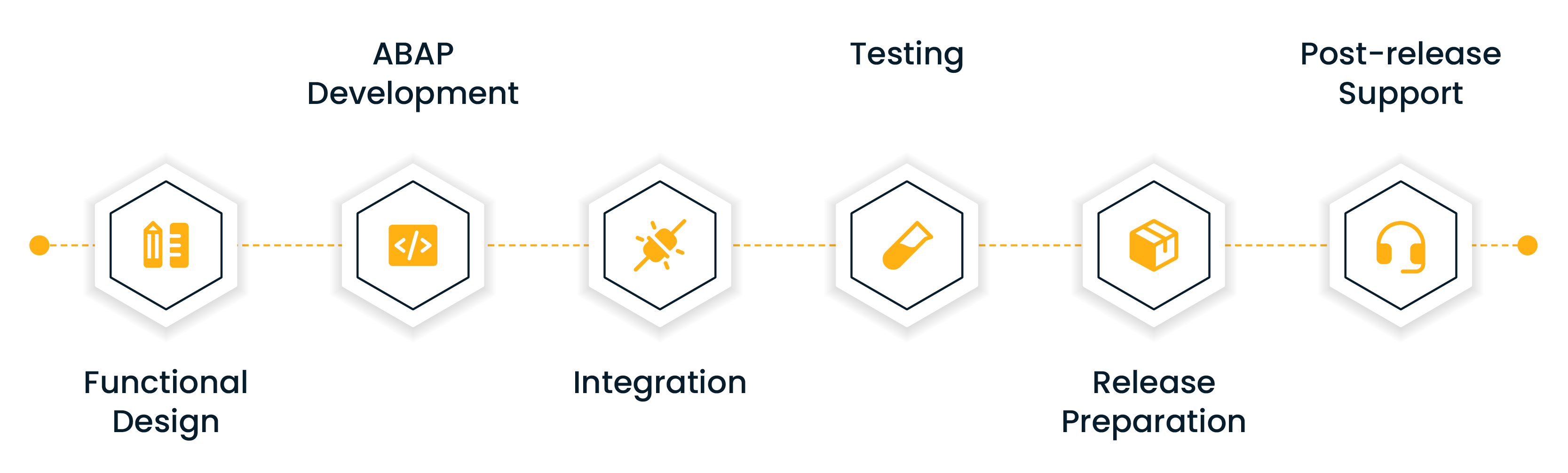
A simple operating model is:
Intake → Qualify → Shape → Build → Validate → Release → Measure
Intake
Capture the business request, desired outcome, affected process, urgency, and requester.
Do not begin with a proposed technical solution.
“Build a custom application” is a solution statement.
“Plant supervisors need to approve this exception without returning to a workstation” describes the actual requirement.
Qualify
Determine whether the request is a defect, configuration adjustment, enhancement, integration requirement, process change, or user issue.
This step prevents the enhancement backlog from becoming a holding area for every unresolved SAP request.
Shape
This is where S/4HANA functional support becomes particularly important.
The functional specialist determines what the requirement means within the SAP process, whether existing functionality addresses it, which downstream processes may be affected, and whether additional technical work is justified.
Build
Only after the requirement has been shaped should the required SAP technical consultants enter development at full capacity.
Depending on the requirement, this may include ABAP, Fiori, SAP BTP, integration, forms, workflows, or other development activity.
Validate
Validation should cover the requested change and the processes around it.
A procurement enhancement may affect accounting.
A manufacturing change may alter inventory movements.
An authorization adjustment may affect controls.
Testing should therefore follow business impact rather than the organizational team that requested the change.
Release
Release preparation covers transports, dependencies, approvals, business calendars, production readiness, and any required support coverage.
Measure
After release, determine whether the enhancement solved the original issue.
If support tickets increase or users create another workaround, the change may technically be complete while the underlying business problem remains.
That final feedback should return to SAP backlog management.
Functional capacity is usually the first control point
When organizations discuss SAP resource shortages, the conversation often moves quickly toward developers.
In practice, development capacity is only useful when the requirement is sufficiently clear.
Strong SAP functional consultants provide the connection between a business request and the SAP design.
They need to understand process dependencies, configuration, business rules, master data, controls, testing implications, and the effect of the requested change on adjacent functions.
Without that work, additional development capacity can simply produce custom functionality faster.
This makes S/4HANA functional support important even when the visible backlog appears highly technical.
A good Talent Pod therefore should not be designed as a pool of programmers waiting for tickets.
Functional analysis should help determine whether development should happen at all.
Technical capacity should follow architectural rules
More delivery capacity creates a governance issue.
If SAP enhancement support becomes easier to obtain, the organization may approve more custom work.
That can undermine the architectural discipline the S/4HANA program was supposed to establish.
SAP’s clean-core guidance recommends keeping the ERP core standardized and upgrade-stable while using supported extensibility models where additional functionality is justified — the architectural discipline that a well-governed RISE with SAP program enforces from the design phase onward to protect long-term upgrade stability. SAP currently distinguishes approaches including on-stack extensibility with ABAP Cloud and side-by-side extensions on SAP BTP, with released interfaces playing an important role in keeping extensions maintainable.
That means every pod needs architectural guardrails.
Before development begins, ask:
- Can standard SAP handle the requirement?
- Can configuration address it?
- Is an approved on-stack extension appropriate?
- Should the capability sit beside the core?
- Which released API or extension point should be used?
- What will happen to this development during an upgrade?
- Who will support it after release?
SAP Talent Pods should increase delivery capacity without increasing unmanaged customization.
Those are two very different outcomes.
Talent Pods are different from staff augmentation
The distinction matters because the delivery models solve different problems.
Traditional staff augmentation generally fills a defined role.
The organization may need an SAP MM consultant for six months or an ABAP developer for a specific project. The customer typically directs the individual’s activities.
A Talent Pod is useful when the requirement is broader than one role.
The backlog may need functional analysis first, development later, integration support for part of the work, and testing around the release. Capacity can therefore be aligned around the work rather than a fixed individual role.
In a standard Talent Pod model, the client can retain control over priorities and delivery decisions while drawing on specialists aligned to the requirements entering the backlog.
A managed pod can add an assigned lead for resource coordination and day-to-day delivery alignment.
That distinction is important.
A Talent Pod should still fit into the customer’s SAP governance model. It should not create a second set of priorities outside it.
Talent Pods are also different from AMS
AMS and Talent Pods can work together, but their primary purposes differ.
A conventional AMS model is generally centered on keeping the productive SAP environment operating. That includes incidents, problems, monitoring, functional and technical support, service requests, changes, and continuous improvement — the full scope of what mature SAP managed cloud services cover as a standing operating commitment beyond ticket resolution.
Talent Pods are more useful when there is a defined stream of enhancement demand that requires flexible functional and technical delivery capacity.
Consider an organization with stable SAP production operations but a 60-item enhancement backlog.
Its AMS team may be meeting incident SLAs while business enhancements continue to wait because enhancement skills are competing with production priorities.
That is a capacity problem around planned change.
A Talent Pod can create a dedicated enhancement lane without requiring the organization to rebuild the support model.
The two can also connect. Recurring AMS incidents can generate SAP AMS enhancements, which then enter the enhancement backlog for analysis, prioritization, and delivery — the continuous improvement cycle that the guide to SAP ERP post go-live optimization describes as the foundation of a mature run-phase operating model.
Do not run one flat enhancement backlog
Another useful improvement is to divide the backlog by readiness.
A single list of 150 requests provides very little delivery information.
Instead, separate work into stages:
- Unqualified demand: Business request exists but analysis has not started.
- Qualified: Requirement and business value are understood.
- Design ready: Functional and architectural decisions are complete.
- Build ready: Dependencies are resolved and technical work can begin.
- Validation ready: Development is complete and testing can start.
- Release ready: Testing and approvals are complete.
This structure helps a flexible SAP talent model allocate the right expertise.
If the organization has 30 items waiting in “Design ready,” adding another functional consultant may provide little value. Technical capacity may be the constraint.
If most requests remain unqualified, adding developers will not accelerate delivery. The bottleneck sits in functional analysis and prioritization.
Capacity should follow the queue structure.
Release planning should determine when capacity expands
SAP enhancement demand also tends to cluster around release windows.
Several changes may need to move through regression testing simultaneously. Integration specialists may be needed for only part of that period. Business users may have narrow validation windows — the release coordination complexity that structured SAP optimization and enhancement services manage by aligning specialist availability with release stage requirements rather than fixed allocation. Production support may need temporary reinforcement immediately after deployment.
This makes fixed staffing inefficient.
A Talent Pod can expand around specific stages of the release cycle and reduce again when the workload changes.
The important point is to scale deliberately.
Do not add capacity simply because the backlog is large.
Add the expertise required to move the highest-value ready work through the next constrained stage.
Measure flow, not utilization
Utilization is a weak primary measure for an enhancement pod.
A consultant can be 100 percent occupied while the backlog moves slowly because work is waiting at handoffs.
More useful measures include:
- Ready-to-start age: How long does approved work wait before delivery begins?
- Waiting-for-Skill Time: How long is work blocked because specialist capacity is unavailable?
- First-pass acceptance: How often does an enhancement pass business validation without substantial rework?
- Backlog carryover: How much committed work repeatedly moves into the next release?
- Reopened change rate: How often does released functionality return because the original requirement was incomplete?
- Unplanned-to-planned ratio: How much pod capacity is consumed by urgent work instead of the agreed enhancement backlog?
These measures tell the organization whether its SAP enhancement support model is improving delivery flow.
When SAP Talent Pods fit, and when they do not
SAP Talent Pods work particularly well when an enterprise already has a defined SAP operating model but enhancement demand changes significantly by skill and release.
They also fit when the organization has strong internal business ownership but cannot economically maintain every specialized SAP capability permanently.
They are less useful when the backlog itself is poorly governed.
If every stakeholder can label a request “urgent,” if architecture decisions have no owner, or if requirements enter development before business analysis, adding a pod will simply increase the speed at which poorly defined work enters the system.
A Talent Pod is also unnecessary when one clearly defined skill gap exists for a fixed period. Traditional staff augmentation may be simpler.
And where the primary requirement is stable production support, incident resolution, monitoring, and SLA-based operations, AMS may be the more appropriate model.
The delivery model should follow the problem.
Scale SAP capacity around the work that is actually waiting
The central question is not how many SAP specialists an enterprise employs.
It is whether the expertise available today matches the work that is ready to move.
A mature S/4HANA functional support model should be able to shape requirements before development begins. Technical specialists should enter where architecture and development genuinely require them. Integration and testing capacity should expand when the backlog reaches those stages.
That is the practical purpose of SAP Talent Pods.
They provide a way to align functional and technical capacity with changing enhancement demand while leaving prioritization, architecture, release governance, and business ownership under control.
For enterprises with a growing S/4HANA enhancement backlog, that distinction matters.
The backlog does not need more people everywhere.
It needs the right expertise at the point where work is waiting.