

The closer an organization gets to its SAP ECC maintenance horizon, the easier it becomes to treat time as the primary migration problem.
SAP currently provides mainstream maintenance for SAP Business Suite 7 core applications, including SAP ERP 6.0, through the end of 2027. Optional extended maintenance is available through the end of 2030.
Those dates matter. They still tell an incomplete story about migration risk.
Two enterprises can begin their SAP S/4HANA programs on the same date and face completely different levels of difficulty. One may have a relatively controlled ECC environment. Another may be carrying twenty years of custom development, duplicated master data, point-to-point integrations, business processes built around obsolete transactions, and reporting dependencies that few people still fully understand.
Calendar readiness and system readiness are therefore separate questions.
A SAP ECC readiness assessment should establish how much work sits between the current landscape and a viable S/4HANA target, supported by structured SAP Implementation Services planning. More importantly, it should show which work needs to happen first.
That requires something more useful than a long ERP readiness checklist. It requires a way to rank risk.
Deadline-led migration planning can distort priorities
When the deadline becomes the organizing principle, SAP programs often start with questions such as target release, implementation partner, infrastructure, project duration, or go-live date.
Those decisions have value. Their reliability depends heavily on what is discovered underneath the ECC system.
SAP itself provides several tools for exposing parts of this condition. SAP Readiness Check can identify relevant simplification items and provide insight into custom code, add-on compatibility, sizing, integration, and other conversion areas. SAP describes the tool as a planning asset for SAP S/4HANA conversion.
The Simplification Item Check serves a different purpose. It verifies technical conditions associated with simplification items. During Software Update Manager processing, unresolved errors can eventually stop the conversion.
This distinction matters for S/4HANA conversion readiness. A planning finding and a conversion blocker do not carry the same risk.
An interface that requires redesign over several business partners may deserve earlier attention than fifty straightforward code corrections. A master-data issue affecting Business Partner conversion may take priority over a larger volume of low-impact technical findings.
Counting findings therefore gives a weak picture of readiness.
Build the scorecard around risk, dependency, and time
A useful S/4HANA readiness scorecard can evaluate each readiness area through three questions.
First, what is the conversion exposure? This asks whether the issue can block conversion, cause a functional failure, create reconciliation problems, or materially affect testing and cutover.
Second, what is the remediation lead time? Some issues are technically simple but organizationally slow. Retiring an interface may require agreement with a bank, supplier, warehouse system provider, or regional business team. Cleaning master data may require business ownership that does not currently exist.
Third, how widely is the issue connected? A problem affecting one report has a different risk profile from a master-data problem affecting procurement, finance, integrations, testing, and cutover.
Each dimension can be rated on a simple scale such as 1 to 5. The scoring method itself is a management framework rather than an SAP-issued score.
One additional field should sit beside the number: evidence confidence.
A risk confirmed through SAP Readiness Check, ATC results, interface discovery, system usage data, or data profiling has stronger evidence than a workshop assumption such as “we think that interface is no longer used.”
That distinction prevents false confidence in the SAP ECC readiness assessment.
Custom code readiness should measure relevance before remediation
Custom code is often assessed by volume. That can produce a misleading workload estimate.
The better question is how much business-relevant custom code needs to survive the move.
SAP’s Custom Code Migration capabilities support SAP S/4HANA checks and can use collected usage information to identify unused custom code. SAP specifically supports scoping the code that needs to be migrated rather than treating the complete custom estate as equally important.
For the scorecard, examine where custom code is used, which processes depend on it, whether standard S/4HANA functionality can replace it, and how deeply it touches changed SAP data structures.
A heavily used Z-program tied to a financially critical closing activity deserves more attention than dozens of dormant objects.
The ECC to S/4HANA assessment should therefore produce a disposition for custom developments such as retain, remediate, replace, or retire. The risk score should rise when remediation is technically complex, usage is high, or several downstream processes depend on the object.
Data readiness includes conversion mechanics and business ownership
Data risk usually appears in several forms at once.
There is volume, which affects sizing and conversion activities. There is quality, which affects whether master and transactional data can be processed reliably. There is historical scope, which influences what must remain available. Then there are structural requirements introduced by S/4HANA.
Business Partner conversion is a good example.
SAP states that customers and suppliers must be converted to Business Partners for an SAP S/4HANA move, with Customer/Vendor Integration in place.
A scorecard therefore needs to look beyond “data cleansing required.” It should ask whether ownership exists for correcting the problem, whether duplicates or incomplete records affect CVI, whether historical information genuinely needs to move, and whether cleanup can happen safely while ECC remains operational.
SAP Readiness Check for ERP Usage and Data Profiling can also provide information about configuration, usage, master and transactional data, and data volumes to support transition planning.
The resulting score should reflect both technical condition and remediation effort.
Integration readiness needs to expose hidden business coupling
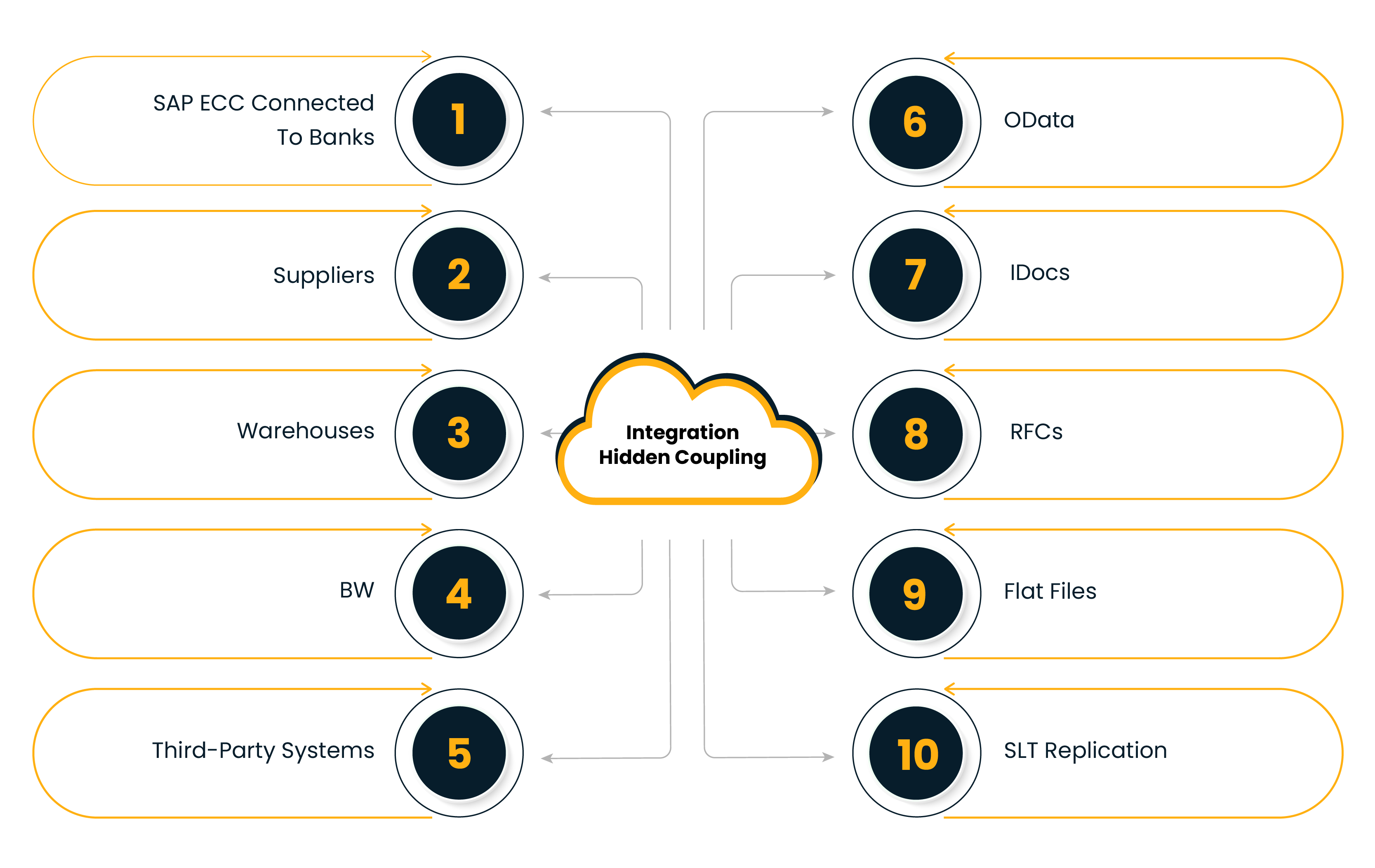
Interfaces are one of the easiest areas to underestimate during an ECC migration risk assessment.
An enterprise may know it has hundreds of interfaces. The number itself says little about migration difficulty.
The important questions concern what each interface touches, how it behaves, who owns the receiving system, whether its structure changes under S/4HANA, and how failures are recovered.
SAP Readiness Check integration analysis can identify interfaces including IDocs, RFCs and BAPIs, web services, OData services, BW extractors, flat-file interfaces, and SLT replication configurations. Its impact analysis can also identify interfaces that may require remediation or reconstruction.
The S/4HANA readiness scorecard should add business context to this inventory.
A low-volume interface sending treasury information to a bank may carry greater business risk than a high-volume internal feed with a straightforward remediation path. A supplier interface may technically be owned by IT while its migration timetable depends on an external trading partner.
Those dependencies are what convert interface inventory into migration risk.
Process readiness should identify where S/4HANA forces a decision
Simplification items should not remain a purely technical workstream.
Some reveal changes that require a business decision about how work will operate after migration, which is why SAP Fiori Readiness Before S/4HANA should be assessed alongside process, role, and user adoption risks. Existing transactions may change. Functionality may have a successor. A workaround developed years ago may no longer make sense in the target environment.
A mature SAP ECC readiness assessment therefore connects simplification findings to process ownership.
For each significant change, determine which business process is affected, who can approve the future-state decision, whether upstream or downstream steps change, and what regression scenarios must be tested.
This is where an SAP discovery assessment becomes particularly important. It connects system findings with how finance, procurement, sales, manufacturing, supply chain, and other functions actually use ECC.
The risk increases when no clear process owner exists or when local variants make one technical change affect several operating models.
Infrastructure readiness is about conversion viability
Infrastructure risk covers more than sizing the future HANA environment.
The ECC to S/4HANA assessment should establish the current release and enhancement package, operating system and database conditions, installed add-ons, active business functions, connected systems, and other technical prerequisites.
Maintenance Planner also evaluates software dependencies during planning. SAP documentation shows that system dependencies, add-ons, and related landscape conditions can affect whether a valid conversion path exists.
Infrastructure therefore deserves a high score when the existing technical baseline introduces prerequisite work before the main conversion can proceed.
This is particularly important when several technical changes are being combined into one program. The issue is not simply whether each change is possible. The assessment needs to determine whether their sequence creates avoidable risk.
User readiness starts with testability
User readiness often gets reduced to training.
Training matters later. Early SAP transformation planning needs a more basic answer: can the business prove that its important processes still work?
That depends on process owners, test scenarios, representative test data, role and authorization validation, reconciliation procedures, business-user availability, and clear acceptance criteria.
A process with no documented regression scenario should score differently from one with stable test coverage and an accountable owner.
The same applies to cutover.
If finance, manufacturing, logistics, or other functions cannot define open-transaction handling, reconciliation responsibilities, and acceptable downtime, the migration carries operational uncertainty even when the system itself appears technically ready.
Business impact prevents technical scores from hiding operational risk
The final dimension asks what happens if the issue survives into migration.
Could it interrupt order processing? Delay a financial close? Affect plant operations? Break supplier communication? Create reconciliation problems? Extend cutover beyond the permitted window?
This business-impact layer changes the meaning of the rest of the scorecard.
A medium technical issue attached to a high-impact process may deserve immediate action. A technically difficult issue in functionality scheduled for retirement may require less investment.
That is why a S/4HANA readiness scorecard should never be treated as a mathematical average of seven categories.
Averages can bury outliers.
If six areas score well and one contains a genuine conversion blocker, the environment cannot reasonably be described as “mostly ready.”
Prioritize four kinds of migration risk
Once the ECC migration risk assessment is complete, findings should be separated by the type of action they demand.
Conversion blockers require resolution before the technical migration can progress safely. Long-lead risks need early action because third parties, data remediation, product decisions, or business approvals may take time. Propagation risks affect several workstreams and can multiply testing or remediation effort. Cutover risks may remain manageable during build yet become serious when production downtime, reconciliation, and business continuity enter the picture.
This classification is more useful than a flat red-amber-green list.
It tells the program why an item is red.
It also stops teams from spending the first months closing easy findings while difficult dependencies remain untouched.
Convert the scorecard into a phased migration roadmap
A strong S/4HANA readiness scorecard should end with sequencing.
The first phase should establish the evidence baseline. Run the relevant SAP checks, inventory the landscape, validate usage, map integrations, profile data, and confirm business ownership.
The next phase should address blockers and long-lead dependencies. CVI preparation, unsupported components, critical custom code decisions, major interface remediation, and significant data problems belong here when they are relevant to the landscape.
The third phase can reduce migration scope. Unused custom code, obsolete interfaces, unnecessary historical data, redundant processes, and avoidable technical debt should be challenged before they are carried forward.
Build and remediation can then proceed against a better understood scope.
The final readiness stage should focus heavily on conversion rehearsals, regression testing, reconciliations, cutover dependencies, user preparedness, and stabilization planning.
This sequence turns SAP transformation planning into a series of evidence-backed decisions rather than a project plan built primarily around a target date, making ERP Transformation easier to govern before S/4HANA execution begins.
Readiness is useful when it changes the plan
The purpose of an ERP readiness checklist is usually to identify what has been reviewed. The purpose of a readiness score is different.
It should change priorities.
A useful SAP ECC readiness assessment shows where migration risk is concentrated, how long remediation may take, which problems cross multiple workstreams, and which decisions must be made before the program moves forward.
For organizations preparing an ECC to S/4HANA assessment, that distinction can materially improve the quality of the roadmap.
A structured SAP discovery assessment can then convert system findings, business dependencies, and readiness scores into an actionable sequence for migration preparation, remediation, testing, and cutover.
That gives the S/4HANA program something more useful than a deadline: a defensible starting position.