

An SAP incident can be resolved in forty minutes and still create a two-week governance problem.
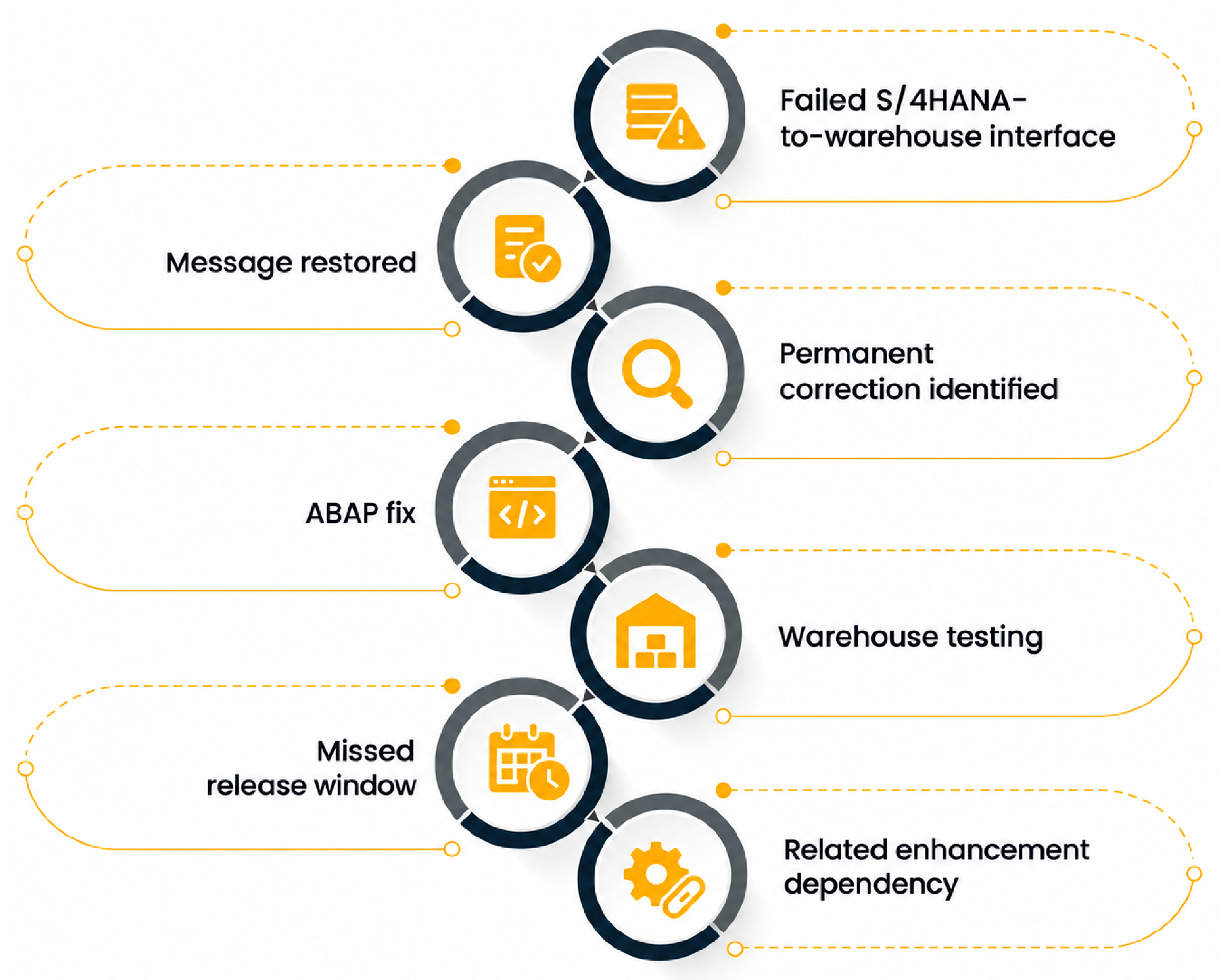
Consider a failed interface between S/4HANA and a warehouse application. Production support restores the message flow
quickly. The incident closes within SLA.
Then the harder work begins.
The integration team identifies a permanent correction. The fix requires an ABAP change. Testing needs input from
warehouse operations. The change misses the current release window. A related enhancement is already waiting in the
same process area. Nobody is certain whether both changes should move together.
Every individual team may be performing well.
The business still waits.
This is where SAP AMS governance is tested. The difficult part of application management is rarely
managing incidents, changes, enhancements, and service levels as separate queues. It is maintaining ownership when work
moves between them.
That creates a useful way to assess an AMS operating model:
How much context, time, and accountability are lost when one type of SAP work becomes another?
Dedicated SAP Talent Pods can reduce that loss by keeping functional, technical, integration, Basis,
and testing knowledge close to the same application landscape across the support lifecycle.
Why Does SAP AMS Need Governance Beyond a Ticketing Process?
SAP production environments generate several distinct types of demand.
An incident needs rapid service restoration. A service request may follow a repeatable fulfilment process. A change
needs impact analysis, testing, approval, and deployment. An enhancement needs business prioritisation, solution
design, and release planning.
Treating them identically creates poor governance.
A useful model separates four core areas:
| Work type | Primary question | Main governance concern |
|---|---|---|
| Incident | How quickly can service be restored? | Priority, ownership, escalation, communication |
| Service request | How consistently can a known request be fulfilled? | Standardisation, automation, turnaround |
| Change | How can the production environment be altered safely? | Impact, testing, approval, deployment |
| Enhancement | Is this improvement worth implementing now? | Business value, capacity, design, release priority |
The problem appears when work crosses those boundaries.
A recurring incident may need a permanent change. A service request may reveal an automation opportunity. An
enhancement can require integration redesign. A failed production change can create a new incident.
Strong SAP production support needs a governance model that follows the work through those transitions, especially
when enterprises choose the right SAP service provider for incidents, changes,
enhancements, and SLA governance.
This is more useful than optimising each queue independently.
Where Does Handoff Loss Appear in SAP Incident Management?
The purpose of SAP incident management is clear: restore normal service and reduce business
disruption.
The incident team may do that very well.
Yet permanent resolution often requires knowledge that sits outside the incident record.
Take a pricing failure in order creation.
Support may restore service by correcting configuration or applying an approved workaround. If the issue keeps
returning, the next questions are different:
- Is the root cause configuration, custom code, master data, or integration?
- Does the business rule still need to exist?
- Who owns the permanent correction?
- Does the correction require a formal change?
- Which processes need regression testing?
- Can the work enter the current release?
- Should another planned enhancement be considered at the same time?
If the incident closes before these questions acquire an owner, the SLA can be met while the underlying support demand
survives.
This is why repeat incidents deserve governance attention beyond resolution time.
The useful measure is not simply whether the ticket was closed. It is whether recurring demand has a controlled route
into problem analysis and permanent remediation.
How Do SAP Talent Pods Change Incident Ownership?
A shared support pool can provide excellent individual specialists. Its weakness appears when context needs to
persist.
A consultant resolves an incident today. Another consultant performs the root-cause analysis next week. An
integration specialist joins later. A developer sees only the technical requirement. Testing receives the final
change without much knowledge of the original production symptom.
Each handoff requires reconstruction.
Dedicated SAP Talent Pods can reduce that reconstruction by keeping a stable team aligned to the
application environment.
The pod may include a combination of:
- SAP functional consultants
- ABAP or technical specialists
- Integration specialists
- SAP Basis expertise
- Test professionals
- Application support coordination
The exact composition should follow the environment and demand profile.
The important characteristic is continuity.
The people working on the permanent fix have access to the production context, business process, related incidents,
previous changes, and surrounding technical dependencies.
That makes escalation more informed and reduces the amount of application knowledge that must be rebuilt each time
work changes category.
What Should SAP SLA Management Actually Measure?
SLAs are necessary because support services need clear expectations.
SAP Cloud ALM’s Business Service Management capability now allows organisations to group systems and services into
business services, define service-level objectives, track service levels, and configure actions for events such as
disruptions, degradations, maintenance, and planned availability.
That supports an important shift in SAP SLA management.
Service levels should reflect the business service being protected, rather than focusing exclusively on individual
infrastructure components or ticket response.
For example, an order-to-cash business service may depend on S/4HANA, integration middleware, an external tax engine,
and another connected application.
All underlying components can be technically online while the end-to-end business service remains degraded.
The governance model should therefore distinguish between:
Ticket SLA: Was the support interaction handled on time?
Service-level objective: Did the business service remain available and usable?
Resolution quality: Did the action remove the problem or merely restore service temporarily?
These measures answer different questions.
A mature AMS review should see them together.
Why Can Green SLA Dashboards Still Hide Poor SAP Support?
SLA reporting tends to reward speed.
That can create misleading confidence when the same work returns repeatedly.
Suppose a monthly review shows:
- 98 percent response SLA achieved
- 96 percent resolution SLA achieved
- No priority-one SLA breaches
The service looks stable.
Now add:
- 22 percent of incidents are repeat issues
- 17 enhancements are older than two quarters
- 14 emergency changes were required
- Three integration problems account for a significant share of operational tickets
- Business users still depend on manual workarounds in two critical processes
The governance picture changes.
This does not make the SLA metrics wrong.
It means they answer only part of the question.
Useful SAP AMS best practices should combine service-level performance with measures such as:
- Repeat incident rate
- Backlog ageing
- Problem-to-change conversion
- Change failure rate
- Emergency change frequency
- Enhancement lead time
- Reopen rate
- Recurring manual interventions
- Monitoring coverage
- Improvement backlog progress
These show whether the support model is improving the environment while maintaining service.
How Should SAP Change Management Connect With Production Support?
A permanent production fix normally needs to become a controlled change.
SAP Cloud ALM supports change and deployment management through features, transports, deployment approvals, release
planning, and traceability. A feature can contain the landscape context and technical change documentation associated
with the deployment. SAP Cloud ALM can also connect requirements, user stories, features, transports, and testing as
work progresses toward production, which supports stronger SAP implementation services during release and
deployment governance.
This creates a useful governance principle for SAP change management:
The context that justified a production change should remain visible through deployment.
If a change originated from a production incident, the team should know:
- Which incident or recurring problem triggered it
- Which business process is affected
- What production behaviour is expected to change
- Which regression tests prove the correction
- Which integrations need validation
- Who accepts the business outcome
- What happens if deployment fails
This traceability becomes particularly important when several small changes are grouped into a release.
The change record should not begin from zero simply because the incident record has been closed.
How Should Enhancement Support Be Governed Differently?
Enhancements create a different challenge.
They compete for the same specialist capacity used to keep production stable.
Without explicit governance, urgent support continually pushes improvements to the side.
Effective SAP enhancement support should therefore separate enhancement demand from break-fix work
while keeping both visible in the same capacity conversation.
A practical enhancement decision should consider:
- Business value
- Urgency
- Process impact
- Technical complexity
- Integration implications
- Clean-core considerations
- Testing effort
- Release dependency
- Specialist capacity
The Talent Pod model can help because enhancement work is performed by people who already understand the supported
environment, while SAP implementation services help convert approved improvements into
structured changes and releases.
That does not mean every support consultant becomes a project developer.
It means the enhancement team starts with application context.
A functional consultant who has seen repeated user issues in a process may identify that an enhancement request is
actually a process or configuration problem. An integration specialist familiar with current interfaces can spot a
dependency before development begins.
That knowledge improves prioritisation.
Where Does SAP Basis Expertise Fit into AMS Governance?
Basis work is often visible only when something goes wrong.
In practice, technical operations influence availability, performance, transports, monitoring, jobs, system health,
and release readiness.
SAP currently supports several operational monitoring capabilities for ABAP-based environments through SAP Cloud ALM,
including Business Process Monitoring, Integration and Exception Monitoring, Real User Monitoring, Job and Automation
Monitoring, Configuration and Security Analysis, and Health Monitoring.
Health Monitoring can track availability, resource trends, and reported errors, while Job and Automation Monitoring
provides visibility into job status, delayed starts, unusual runtimes, and other execution behaviour.
Dedicated Basis expertise in a Talent Pod can connect those technical signals with the wider support process.
A recurring job failure, for example, should not remain a monitoring alert indefinitely.
The pod can determine whether the issue requires scheduling changes, application correction, performance tuning, code
changes, or process redesign.
The value lies in making technical operations part of application governance rather than a separate infrastructure
queue.
How Should Integrations Be Governed Across Incidents and Changes?
Integrations create some of the most expensive handoffs in SAP support.
The SAP functional team sees missing business data. The integration team sees a failed message. The external
application owner sees a different error. Nobody initially owns the end-to-end outcome.
SAP Cloud ALM’s Integration and Exception Monitoring provides visibility into messages, exceptions, and alerts across
managed components and supports business-impacting alert scenarios.
Monitoring can identify the failure.
Governance determines who owns resolution.
For important interfaces, the AMS model should define:
- Functional owner
- Technical or integration owner
- External application owner
- Escalation path
- Business impact
- Monitoring mechanism
- Restart or recovery procedure
- Permanent-fix route
- Test requirements for interface changes
A Talent Pod helps by keeping SAP functional and integration skills inside the same operating structure.
The interface stops being “someone else’s system” as soon as it crosses the SAP boundary.
What Documentation Should a Talent Pod Maintain?
Documentation should reduce dependence on memory without becoming a library nobody uses.
The most useful AMS documentation is operational.
That includes:
- Known-error records
- Resolution procedures
- Escalation contacts
- Integration ownership
- Critical job calendars
- Business-process dependencies
- Release history
- Configuration decisions
- Custom-code ownership
- Recurring incident patterns
- Test evidence
- Major business-calendar events
- Cutover and rollback procedures for significant changes
Documentation should evolve with the supported environment.
A stable Talent Pod has an advantage here because the people consuming the documentation are also improving it.
When a new dependency is discovered during an incident, it can become part of the operational record instead of
disappearing when the ticket closes.
How Should Release Coordination Work Under SAP AMS Governance?
Releases are where incidents, changes, and enhancements converge.
A release may contain a production correction, several minor enhancements, an integration update, configuration
changes, and security adjustments, which is why SAP S/4HANA migration programmes need strong
release governance after go-live.
Each item can be valid on its own while creating risk when deployed together.
SAP Cloud ALM supports release and deployment planning where features can be grouped into releases, linked to
transports, tested, and confirmed in production. SAP’s end-to-end implementation guidance also supports traceability
between requirements, features, test cases, and deployment.
The AMS governance model should use release coordination to answer:
- Are dependent changes moving together?
- Has regression scope been agreed?
- Are business owners available for validation?
- Are external systems ready?
- Is the deployment window appropriate?
- Are rollback conditions understood?
- Are emergency changes colliding with planned work?
- Who owns post-deployment verification?
Talent Pods can improve release coordination because the same team sees work before and after deployment.
Production support knowledge feeds release planning, and release knowledge returns to production support.
That closes an important loop.
What Should an SAP AMS Governance Review Look Like?
A useful governance model operates at several levels.
Daily operational control
Review critical incidents, major service disruptions, urgent escalations, failed integrations, failed jobs, and
immediate business risk.
Weekly work governance
Review incident recurrence, problem investigations, pending changes, enhancement priorities, ageing requests,
dependencies, and specialist capacity.
Release governance
Confirm change readiness, test evidence, business validation, integration dependencies, deployment approvals, and
rollback plans.
Monthly service review
Evaluate SLA and service-level performance alongside repeat incidents, backlog health, change quality, enhancement
throughput, monitoring coverage, and improvement progress.
Improvement review
Decide which recurring problems, manual activities, technical debt, process friction, or monitoring gaps should
receive dedicated improvement capacity.
This is where SAP AMS governance becomes more than administration.
It directs limited SAP expertise toward the work with the greatest operational and business impact.
What Should Talent Pods Be Accountable For?
A Talent Pod should not be measured solely by how many tickets its members close.
Its accountability should reflect the broader operating model.
That can include:
- Service stability
- SLA performance
- Quality of incident resolution
- Reduction in recurring incidents
- Root-cause closure
- Change success
- Release readiness
- Enhancement delivery
- Documentation quality
- Monitoring effectiveness
- Reduction of manual support effort
- Continuous-improvement progress
The exact measures should follow the agreed service scope.
The important point is that dedicated talent should have enough continuity to influence those outcomes.
If a team is held responsible only for ticket throughput, it will optimise ticket throughput.
If it has ownership across production support, changes, enhancements, and improvement, it can make better trade-offs
across the SAP application lifecycle.
What Does Good SAP AMS Governance Look Like in Practice?
Good governance does not eliminate queues.
Incidents still need rapid response. Service requests still need predictable fulfilment. Changes still need control.
Enhancements still need prioritisation.
What changes is the quality of movement between them.
A recurring production issue keeps an owner when it becomes a change. A change retains the original business context
through testing. An enhancement enters a release with known dependencies. Monitoring alerts have defined response
paths. SLA discussions include service quality and recurrence. Documentation improves as the landscape changes.
Dedicated SAP Talent Pods can support this model because functional, technical, integration, Basis,
and testing expertise remain close enough to the environment to preserve context across those transitions.
That is the larger opportunity in SAP production support.
The aim is not simply to process four different types of work efficiently. It is to prevent incidents, requests,
changes, and enhancements from becoming four disconnected views of the same SAP environment.
When governance keeps ownership intact across those boundaries, application management becomes easier to control,
releases become more predictable, recurring issues are more visible, and scarce SAP expertise is spent with greater
intent.